
Corporate Performance & Engagement
Your Workforce Can Only Perform With the Capacity They Bring to Work
Organizations invest heavily in strategy, leadership, technology, training, and culture to help their people perform at their best.
But all of those investments depend on one thing:
The person who shows up to use them.
When employees are well-recovered, they have greater capacity to focus, make decisions, adapt to stress, communicate, and perform.
But when people consistently show up tired, stressed, and under-recovered, even simple demands can become harder.
Focus fades.
Patience decreases.
Decision-making becomes more difficult.
Stress feels heavier.
And maintaining performance throughout the day becomes harder.
The traditional response is often to ask people to focus more, manage their stress, be more productive, or simply push through.
But you can't continually ask more from someone whose body doesn't have more to give.
That's why we take a different approach.
Instead of only asking:
“How do we get more out of our people during the day?”
We also ask:
“How do we help our people recover better at night so they have more to bring into their day?”
Because sleep and recovery aren't simply personal health issues.
They're performance issues.
And helping your workforce Wake Up Ready™ may be one of the most overlooked opportunities for improving how they show up, perform, and engage at work.
A Different Approach To Workforce performance
Wake Up Ready™ . Show up Work Ready™
Most programs focus on improving what employees do during the day.
We start with how well they recover at night.
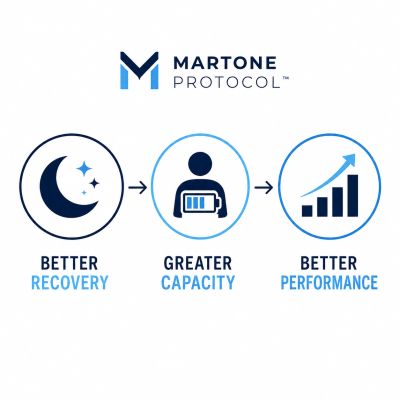
Better recovery gives people greater capacity the energy, focus, clarity, and resilience they need to perform.
Better Recovery → Greater Capacity → Better Performance.
Help your company Wake Up Ready™ to Show Up Work Ready™.
we customize programs to improve workforce performance
Corporate Speaking & Keynotes

Educate. Engage. Inspire Change.
International speaker Dr. Peter Martone delivers engaging, interactive presentations that help audiences understand the connection between stress, sleep, recovery, and performance.
More than just education, his presentations give employees practical strategies they can experience and apply immediately, helping inspire real change in how they recover, feel, and perform.
Wake Up Ready™. Show Up Work Ready™.
Corporate Workshops
Corporate Workshops
Bring Dr. Martone onsite for a one-day interactive training designed to teach your employees how to recognize the patterns driving their stress—and practical skills to help their nervous system process that stress more effectively.
Employees leave with tools they can use immediately to manage stress, improve recovery, and show up more focused, resilient, and ready to perform.
Wake Up Ready™. Show Up Work Ready™.
Employee Performance Programs
Employee Performance Programs
Implement & Sustain
For organizations looking to create change beyond a single event, our Employee Performance Programs bring the principles of recovery into everyday life.
Employees learn practical strategies to better manage stress, improve sleep and recovery, and build the capacity to meet the demands of both work and life.
The goal isn't to give your people more to do.
It's to help them have more to give.
When Employees Recover they perform better

Employees show up with greater energy and focus
Engagement increases because work feels more manageable
Execution becomes more consistent across teams
Execution becomes more consistent across teams
Engagement increases because work feels more manageable
Execution becomes more consistent across teams
Burnout risk and fatigue-driven errors start to decline
Engagement increases because work feels more manageable
Engagement increases because work feels more manageable
Engagement increases because work feels more manageable
Engagement increases because work feels more manageable
Engagement increases because work feels more manageable

BRING WAKE UP READY™ TO YOUR ORGANIZATION
Your people can only perform with the capacity they bring to work each day.
We don't ask employees to simply do more.
We help them have more to give.
More energy.
More focus.
More resilience.
More capacity to perform.